

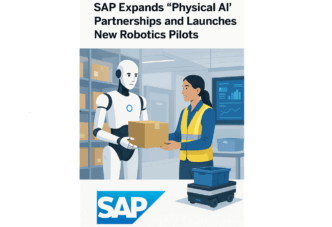

SAP is accelerating its efforts to merge artificial intelligence with robotics through its “Physical AI” initiative, which aims to integrate intelligent, autonomous machines directly into enterprise operations. The company announced a series of new partnerships and pilot projects designed to connect robots with SAP’s business software, enabling real-time, adaptive, and data-driven workflows across industries such as manufacturing, logistics, and field services.
Early results from SAP’s Embodied AI pilots have been promising — with up to a 50% reduction in unplanned downtime, a 25% boost in productivity, and fewer operational errors. The company’s advantage lies in its ability to tie robotic actions directly to enterprise data and processes, transforming robots from isolated automation tools into intelligent business assets.
Real-World Pilot Highlights
- BITZER and NEURA Robotics: In a warehouse logistics pilot, a humanoid robot named 4NE1 performed autonomous item picking. It was trained using NVIDIA’s Isaac Sim and fully integrated with SAP S/4HANA and SAP Business Technology Platform. The setup enabled continuous operation, real-time responsiveness, and seamless order management.
- Sartorius: A proof-of-concept demonstrated how cognitive robots can collaborate with humans in a dynamic warehouse setting. By leveraging SAP Extended Warehouse Management (EWM), the system showed how companies can move from fixed automation to flexible, intelligent robotics.
- Martur Fompak: In partnership with Humanoid, SAP tested how humanoid robots could handle repetitive and physically demanding warehouse tasks such as picking and tray loading across multiple global plants.
Expanding the Ecosystem
SAP also revealed an expanded ecosystem of robotics manufacturers and integration partners to scale embodied AI across industries. 
Robotics partners include:
- AgiBot: Creator of a versatile embodied-robot platform with an integrated application ecosystem.
- ANYbotics: Specializes in autonomous inspection robots that help predict and prevent maintenance issues.
- Booster Robotics: Builds humanoid robots designed for warehouse and field maintenance operations.
- Galbot: Develops humanoids equipped with vision-language-action models for industrial, retail, and healthcare environments.
- Unitree Robotics: Produces quadruped and humanoid robots for navigation, inspection, and facility management tasks.
Integration and enablement partners include:
- Capgemini: Collaborating on multi-agent AI, humanoids, and spatial computing within SAP environments.
- Cyberwave: Bridges SAP systems with the physical world through digital twins and sensor data.
- HCLTech: Provides AI-driven robotics integration expertise to accelerate generative-AI solutions.
- KINEXON Industries: Offers a vendor-agnostic platform for managing mixed fleets of robots and vehicles within SAP ecosystems.
- Lighthouse: Focuses on asset and quality inspections powered by SAP Intelligent Asset Management and Business AI.
- SinoSwissHub: Provides a compliant, SAP-connected orchestration platform for humanoid and multi-robot fleets.
Why It Matters
SAP’s “Physical AI” vision aims to make robots aware of business context — allowing them not only to execute tasks but also to understand priorities, make intelligent decisions, and adapt to change. By embedding robotics directly into enterprise systems, organizations can achieve greater efficiency, flexibility, and resilience in operations.
This marks a shift from traditional automation to a new era of context-aware robotics, where intelligent machines become active participants in business processes rather than standalone tools.
Looking Ahead
SAP is inviting customers and partners to explore its reference architecture for embodied AI and join its growing initiative. The company believes these innovations could redefine how businesses operate — enabling robots to act as intelligent extensions of enterprise systems and setting a new standard for the future of autonomous operations.